
Importance of CROWNS and coronal coverage
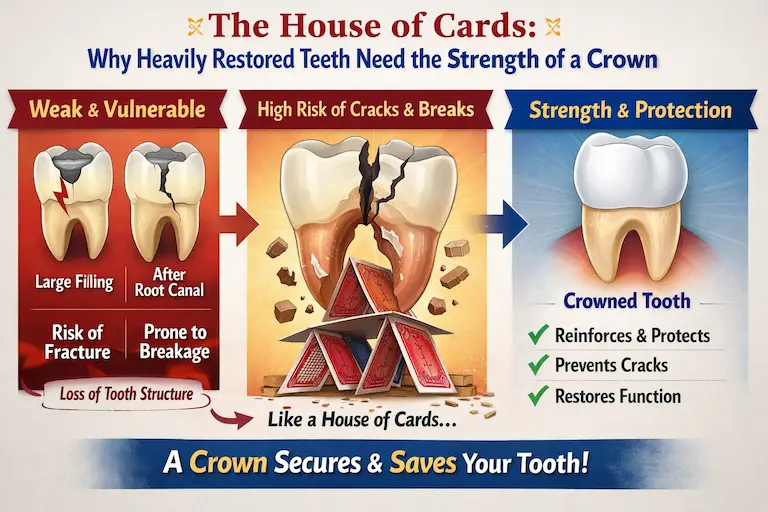
The House of Cards: Why Heavily Restored Teeth Need the Strength of a Crown
In our previous discussions, we explored how missing teeth can lead to bone loss and how gum disease impacts your body. Today, we are looking at a different kind of risk: the risk hiding inside a tooth that looks fine but has been through a lot.
If you have a tooth that has a large filling, or if you have recently undergone a root canal, you might wonder why your dentist recommends a crown. It is a common question: “Why can’t I just get another filling?”
The answer lies in the physics of chewing and the biology of your tooth structure. Based on decades of clinical research, we know that teeth with extensive structural loss are at a high risk of catastrophic failure. Here is the science behind why coronal coverage—a crown—is one of the most important investments you can make to save your tooth.
The Myth of the “Brittle” Tooth
For years, dentists believed that root canal treated teeth failed because they became “brittle” due to dehydration. However, more recent scientific investigation has disproven this theory. Studies have shown that the physical and mechanical properties of dentin (the hard tissue beneath the enamel) do not significantly change after a tooth loses its nerve .
So, if the tooth isn’t brittle, why is it weaker?
The answer is simple: Loss of structural integrity.
A tooth that requires a root canal or a massive filling has usually been through significant trauma—whether from decay, fractures, or previous large restorations. The weakness isn’t from the root canal itself, but from the missing tooth structure.
The Biomechanics of a Broken Tooth
To understand this, think of a tooth like a chair. An intact tooth with a small filling is like a solid wooden stool. A tooth with a large cavity and a massive filling is like a chair with three legs—it might hold you if you sit perfectly still, but the moment you shift your weight (or in this case, chew), the stress is uneven and catastrophic.
Research confirms this mechanically. Studies on tooth stiffness have found that the loss of tooth structure during cavity preparation has a dramatic effect on the tooth’s ability to handle force.
- Losing an occlusal surface (the top of the tooth) reduces tooth stiffness by roughly 20% .
- Losing a marginal ridge (the edge of the tooth that contacts a neighbor) causes a further reduction.
- A full MOD (mesial-occlusal-distal) cavity preparation—where the filling goes across the entire biting surface and involves both sides of the tooth—reduces the stiffness of the tooth by a staggering 63% .
When a tooth loses that much stiffness, every time you bite down, the cusps of the tooth flex and bend. A filling simply fills the space; it does not glue the cusps back together. Over time, this flexing leads to cracks, and eventually, the cusp breaks off.
The Evidence: Six Times Greater Survival Rate
The link between cuspal coverage and long-term success has been well-documented. One of the most widely cited retrospective studies examined over 1,200 root canal treated teeth over a period of up to 25 years .
The findings were definitive:
- Anterior teeth (front teeth) did not show a significant difference in survival with or without crowns, as they are not subjected to the heavy, wedging forces of chewing.
- Posterior teeth (premolars and molars) showed a significant improvement in clinical success when protected by a full cast crown .
In fact, research has concluded that endodontically treated posterior teeth with crowns had a survival rate six times greater than that of teeth without crowns . Another study reported the greatest failure rate—24.2% —was recorded for root canal treated teeth that did not receive a crown .
Waiting too long to place that crown can also be detrimental. Research suggests that a delay of more than four months between the completion of root canal treatment and crown placement can negatively impact long-term survival rates .
The “Ferrule” Effect: The Science of Holding a Tooth Together
So, how does a crown work? It is not just a cap; it is a protective splint that utilizes a principle known as the ferrule effect.
In engineering, a ferrule is a band that surrounds and holds together the end of a stick or tube (like the metal band on a paintbrush that holds the bristles). In dentistry, the ferrule is the amount of healthy tooth structure that extends up above the gumline and inside the crown.
According to restorative dental texts, to adequately protect a tooth from fracture, we need at least 1.5mm to 2mm of healthy, solid tooth structure remaining above the gum line . The crown fits over this “wall” of natural tooth, encircling it like a barrel hoop. This ferrule does two things:
- It resists forces: It prevents the cusps from flexing outward and splitting the tooth.
- It distributes stress: It redirects chewing forces down the long axis of the root, where the tooth is strongest .
If that remaining tooth structure is too short or too thin (less than 1mm of dentin thickness), the tooth is set up for failure . This is why sometimes, if a tooth is broken down too far, we may recommend crown lengthening surgery to expose more tooth structure before a crown can be placed—because without that ferrule, the tooth will almost certainly fracture again.
Composite vs. Crown: What Does the Latest Research Say?
With modern adhesives, some patients wonder if a large “white filling” (composite resin) can do the same job. The research is nuanced and depends entirely on how much tooth you have left.
- For Minimal Loss: A 2017 systematic review found that in teeth with “minimum to moderate loss of tooth structure” (generally defined as having no more than 3 surfaces missing), there was no significant difference in survival rates between a high-quality bonded composite and a crown .
- For Extensive Loss: However, for teeth that are heavily restored or have undergone root canal treatment, the equation changes. Direct composite restorations do not provide adequate cuspal protection for posterior teeth subjected to heavy loads unless the access opening is very conservative . A crown, which encases the entire tooth, prevents the catastrophic cusp fractures that composites cannot .
A long-term 17-year study published in the Journal of Dentistry summarized the most important factor simply: “The most important restoration survival factor seemed to be the amount of remaining coronal tooth structure” .
Protecting Your Investment
If you have spent the time and resources to save a tooth with a deep filling or a root canal, it is vital to protect that investment. Placing a crown on a compromised tooth is like putting a helmet on a football player—it protects the most vulnerable part from the inevitable impacts of daily function.
A tooth fracture is often a “catastrophic failure.” It usually means the tooth splits in a way that cannot be repaired, leading to extraction. Don’t let a tooth you worked hard to save end up being lost because it wasn’t protected.
If your dentist has recommended a crown for a back tooth, it is not just a suggestion—it is evidence-based medicine designed to keep your smile intact for decades to come.
Ready to Book Your Appointment?
Looking for a trusted dentist in Rockwood? Our team at Ridge Square Dental is here to provide comfortable, personalized care for you and your family.
Ridge Square Dental
167 Jolliffe Ave, Unit 7, Rockwood, Ontario, N0B 2K0
We proudly welcome patients from Rockwood, Guelph, Acton, Georgetown, Milton, and Fergus.