
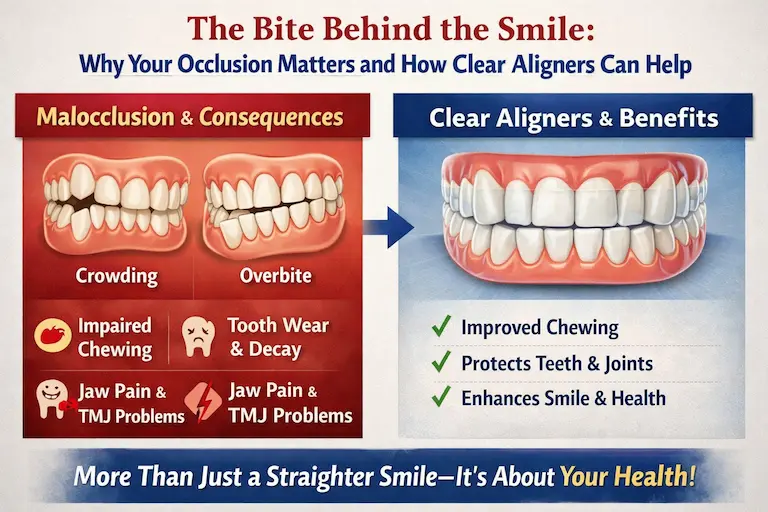
Malocclusion
The Bite Behind the Smile: Why Your Occlusion Matters and How Clear Aligners Can Help
When you think about orthodontic treatment, you probably picture straighter teeth and a more photogenic smile. While aesthetics are a wonderful benefit, they are just the surface of a much deeper story.
At its core, orthodontics is about correcting malocclusion—a clinical term for a misaligned bite. The way your top and bottom teeth come together (or fail to) affects everything from your digestion to your jaw joint health. Ignoring a bad bite can set off a chain reaction of problems that extend far beyond crooked teeth.
Using the latest evidence from 2024 and 2025, let’s break down the problem of malocclusion, the consequences of leaving it untreated, and the modern solution offered by clear aligner therapy.
The Problem: Malocclusion is More Than “Crooked Teeth”
Malocclusion is identified by the World Health Organization (WHO) as one of the top three oral diseases globally, posing a significant challenge to public health . It refers to a abnormal growth and development of the jaws and teeth, influenced by genetics, environment, or harmful oral habits .
Common types include crowding, spacing, deep bites, open bites, and crossbites. But why does this matter? Because a properly functioning mouth relies on a stable bite.
The Evidence:
Research highlights that malocclusion can have a negative impact on oral functions including mastication (chewing), swallowing, and speech . When the teeth don’t meet correctly, the entire system is thrown off balance.
The Consequences: The Domino Effect of a Bad Bite
If malocclusion is left untreated, the consequences cascade through your physical, dental, and mental health. The evidence points to three major areas of impact.
- Physical Health: From Digestion to Breathing
The first consequence is a decline in function.
- Impaired Chewing: Misalignment reduces the functional contact area of your teeth, leading to lower masticatory efficiency . This is the first step of digestion; when it fails, you may swallow larger food particles, leading to gastrointestinal discomfort and even nutritional deficiencies over time .
- Systemic Connections: Orthodontic treatment is now linked to improved overall health outcomes, particularly in cases involving respiratory issues. For individuals with malocclusion and obstructive sleep apnea (OSA) , orthodontic intervention can be life-changing. Mandibular retrusion (a recessed lower jaw) is a contributing factor to OSA, which causes sleep disturbances, neurocognitive issues, and even cardiovascular strain .
- Oral Health: Trauma, Decay, and Joint Pain
A misaligned bite creates a hostile environment for your teeth and gums.
- Increased Risk of Trauma: Protruding upper incisors (often seen in Class II malocclusion) are significantly more susceptible to dental trauma from falls or impacts .
- Difficulty Cleaning: Crowding creates nooks and crannies where plaque accumulates. This leads to an increased risk of dental caries (cavities) and gingival periodontal disease .
- Temporomandibular Joint (TMJ) Disorders: Occlusal interferences can alter the trajectory of mandibular movements. This can induce perioral muscle fatigue and contribute to temporomandibular joint dysfunction, potentially leading to chronic pain and even organic pathology within the joint itself .
- Psychological Well-Being: The Social Burden
The psychosocial impact of malocclusion is profound and well-documented.
- Self-Esteem and Bullying: Orthodontic treatment has a positive impact on emotional and social well-being . Conversely, visible malocclusion (like large gaps or severely misaligned teeth) is a potential reason for children and adolescents to be teased or bullied. This can lead to social isolation, low self-esteem, and difficulty interacting with others .
- Quality of Life: Research confirms that malocclusion negatively affects Oral Health-Related Quality of Life (OHRQoL) . Orthodontic treatment, by improving appearance and function, boosts social confidence in both adolescents and adults, benefiting interactions in school and the workplace .
The Solution: Clear Aligner Therapy
For decades, the only solution to significant malocclusion was traditional braces. Today, Clear Aligner Therapy (CAT) offers a highly effective, esthetic, and patient-friendly alternative—but only when applied to the right cases.
What Does the Evidence Say About Aligners?
Recent systematic reviews and expert consensus papers from 2024 and 2025 provide a clear picture of where aligners excel.
- Effectiveness in Mild to Moderate Cases
The consensus is strong: For non-extraction cases and simpler malocclusions, clear aligners achieve comparable occlusal results to traditional fixed appliances . A systematic review published in late 2025 confirmed that in mild to moderate cases, there is no significant difference in treatment quality between aligners and braces .
- Biomechanics: How They Move Teeth
Aligners are exceptionally good at certain movements.
- Tipping Movements: Most dentoalveolar malocclusions are resolved through controlled tipping movements, where aligners show consistently high effectiveness .
- Rotations: The predictability of rotational tooth movement with aligners is improving, with current studies showing accuracy ranging from 36% to 85%, averaging around 65% . The use of attachments and optimized staging protocols helps achieve these movements .
- Patient-Centered Benefits
This is where aligners truly shine compared to traditional braces.
- Improved Comfort and Oral Hygiene: Aligners are heralded for their better esthetics, convenience, and superior periodontal health compared to brackets and wires. Because they are removable, maintaining excellent oral hygiene is significantly easier .
- Enhanced Quality of Life: Systematic reviews report substantial improvements in patient satisfaction and Oral Health-Related Quality of Life (OHRQoL) during aligner treatment. The esthetic nature of the appliances reduces the self-consciousness that often accompanies orthodontic treatment .
- The Limitations (Knowing When to Choose Braces)
It is important to be transparent about what aligners cannot do. The evidence shows that for complex, severe malocclusions (such as those requiring significant extractions or bodily tooth movement), fixed appliances still demonstrate superior control and a higher standard of finish . Complex movements like root torque and extrusion are less predictable with aligners .
However, for the vast majority of adults seeking to improve a misaligned bite, clear aligners offer a predictable, comfortable path to a healthier mouth.
A Note on Holistic Health
Correcting occlusion with aligners isn’t just about straight teeth. By resolving the bite, we address the root of the issues mentioned above: we create a stable platform for chewing (improving digestion), reduce the risk of trauma and decay (improving oral health), and alleviate the strain on jaw joints. Furthermore, by expanding arches or correcting jaw position in growing children, orthodontists can play a key role in managing airway health .
Conclusion
Malocclusion is a significant health burden, impacting physical function, oral health, and psychological well-being. The consequences of leaving it untreated—decay, joint pain, low self-esteem, and even sleep-disordered breathing—are too significant to ignore.
Thanks to modern digital orthodontics, clear aligner therapy offers a scientifically validated solution for correcting the bite in a way that fits seamlessly into your lifestyle. Whether you suffer from jaw pain, difficulty cleaning crowded teeth, or simply want to invest in your long-term health, it is worth exploring how aligning your bite can transform your life.
Have you considered the health of your bite? Schedule a consultation with us today to see if clear aligners are the right solution for you.
References:
The information in this blog is supported by peer-reviewed studies published in 2024 and 2025, including systematic reviews from the Journal of Evidence-Based Dental Practice, Seminars in Orthodontics, the European Journal of Orthodontics, and the International Journal of Oral Science
Ready to Book Your Appointment?
Looking for a trusted dentist in Rockwood? Our team at Ridge Square Dental is here to provide comfortable, personalized care for you and your family.
Ridge Square Dental
167 Jolliffe Ave, Unit 7, Rockwood, Ontario, N0B 2K0
We proudly welcome patients from Rockwood, Guelph, Acton, Georgetown, Milton, and Fergus.