
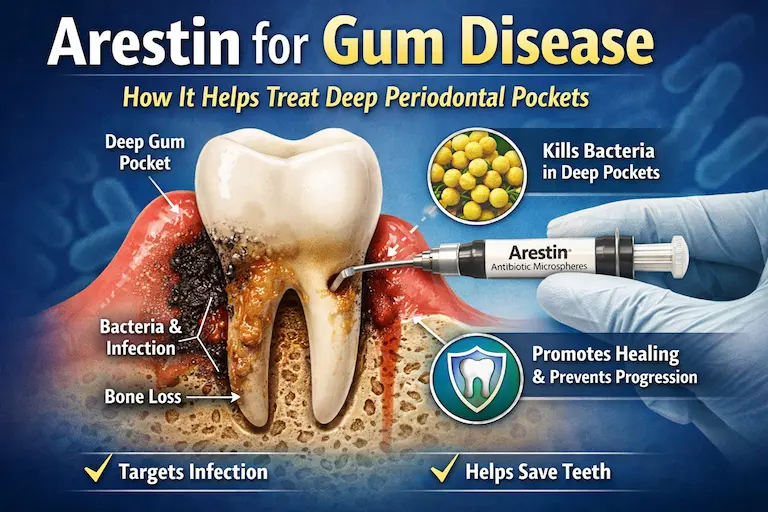
Arestin for Gum Disease: How It Helps Treat Deep Periodontal Pockets
Arestin: Closing the Gap: How Arestin Therapy Can Stop Periodontal Disease in Its Tracks
You’ve likely heard us talk about the importance of treating gum disease—not just for your smile, but for your overall health. You may have even undergone scaling and root planing, often called a “deep cleaning.”
But what happens when that deep cleaning isn’t quite enough? What if those stubborn pockets around your teeth refuse to close?
This is where Arestin enters the conversation. It’s not a replacement for deep cleaning—it’s a scientifically proven partner that can mean the difference between stabilizing your gum disease and watching it progress to tooth loss.
Let’s explore the problem of persistent periodontal pockets, the consequences of leaving them untreated, and the evidence-based solution that Arestin provides.
The Problem: Why Deep Cleaning Sometimes Falls Short
Scaling and root planing (SRP) is the gold standard, first-line treatment for periodontitis . By mechanically removing plaque, calculus, and bacterial deposits from tooth roots and periodontal pockets, SRP reduces bacterial load and gives your gums a chance to heal .
However, SRP has limitations. Deep periodontal pockets—typically those measuring 5 mm or deeper—pose a significant challenge. The instruments used during SRP simply cannot reach the bottom of these pockets effectively. Pathogenic bacteria, particularly anaerobic gram-negative organisms, can remain lodged deep within the pocket, sheltered from mechanical disruption .
The Microbial Challenge:
These residual bacteria don’t just sit idly. They continue to multiply, release toxins, and trigger your immune system’s inflammatory response. This ongoing cycle prevents the pocket from closing and allows the disease to silently progress—even if your gums look pink and healthy on the surface .
The Anatomy of Failure:
Research confirms that the inaccessibility of deep-seated polymicrobial biofilms limits SRP’s effectiveness . When bacteria hide in areas instruments cannot reach, mechanical therapy alone may fail to eliminate them .
The Consequences: What Happens When Pockets Persist
When periodontal pockets remain deep after SRP, the consequences cascade through your oral and systemic health.
- Progressive Bone and Attachment Loss
Deep pockets are not just spaces—they are active disease sites. The persistent inflammation continues to destroy the periodontal ligament and alveolar bone that support your teeth. Over time, this leads to:
- Increased clinical attachment loss (the detachment of gum tissue from the tooth)
- Progressive bone resorption visible on dental radiographs
- Eventually, tooth mobility and loss
- Reservoir for Pathogenic Bacteria
Persistent pockets serve as a breeding ground for “red complex” bacteria—the most virulent periodontal pathogens. These bacteria can:
- Spread to previously healthy sites in your mouth
- Enter your bloodstream through the ulcerated pocket lining
- Contribute to systemic inflammation linked to cardiovascular disease, diabetes complications, and adverse pregnancy outcomes
- Compromised Response to Future Treatment
The longer pockets remain active, the more difficult they become to treat. Chronic inflammation leads to fibrotic changes in the gum tissue, making it harder for pockets to resolve even with additional intervention. What might have been manageable with non-surgical therapy can progress to requiring periodontal surgery .
- Systemic Health Burden
The inflammatory mediators produced in persistent periodontal pockets—including TNF-alpha, IL-6, and IL-1β—enter the circulation and contribute to low-grade systemic inflammation . This adds to your body’s overall inflammatory burden and can complicate the management of systemic conditions like diabetes .
The Solution: Arestin as an Evidence-Based Adjunct
This is where Arestin (minocycline hydrochloride microspheres) enters the picture. Arestin is not a standalone treatment—it is an adjunctive therapy designed to be placed after scaling and root planing to target the bacteria that mechanical instrumentation missed .
What Is Arestin?
Arestin consists of tiny, bioabsorbable microspheres containing minocycline, a broad-spectrum antibiotic in the tetracycline family . These microspheres are delivered directly into the periodontal pocket, where they:
- Release minocycline gradually over time (typically 14-21 days)
- Target residual bacteria at therapeutic concentrations
- Then completely bioabsorb, leaving nothing behind to remove
The Mechanism: Why Local Delivery Matters
The advantage of local delivery is precision. Systemic antibiotics expose your entire body to medication, risking side effects and contributing to antibiotic resistance . Arestin delivers the drug exactly where it’s needed—directly into the pocket—at concentrations far higher than systemic antibiotics could achieve, while minimizing systemic exposure .
What the Science Shows:
A 2023 systematic review and meta-analysis published in the International Journal of Pharmaceutical Sciences and Research evaluated multiple randomized controlled trials comparing SRP alone to SRP plus minocycline microspheres . The findings were clear:
- Greater pocket depth reduction: Patients receiving Arestin as an adjunct demonstrated significantly greater reductions in probing pocket depth compared to SRP alone .
- Improved clinical attachment levels: The combination therapy resulted in better gain of clinical attachment—meaning the gums reattached more effectively to the tooth surface .
- Sustained benefits: These improvements were maintained at follow-up periods ranging from 6 to 24 months .
The Numbers: Quantifying the Benefit
A landmark multi-center trial published in the Journal of Periodontology enrolled 748 patients with moderate to advanced periodontitis and randomized them to SRP alone, SRP plus vehicle, or SRP plus minocycline microspheres . The results demonstrated:
- Statistically significant probing depth reduction in the minocycline group compared to SRP alone
- Benefits observed as early as one month and maintained throughout the 9-month trial
- Effectiveness independent of smoking status, age, gender, or baseline disease severity
A comprehensive systematic review and meta-analysis published in the Journal of Clinical Periodontology and summarized in the Journal of the American Dental Association confirmed these findings across multiple agents . For minocycline specifically, the adjunctive benefit was:
- Mean additional pocket depth reduction: 0.47 mm (95% CI: 0.42-0.52 mm)
- Mean additional clinical attachment gain: 0.19 mm (95% CI: 0.13-0.25 mm)
While these numbers may seem modest, they represent the difference between a pocket that remains diseased and one that closes to a maintainable, healthy depth.
Beyond Pocket Reduction: Additional Benefits
Recent research suggests Arestin’s benefits may extend beyond local pocket closure. An ongoing randomized controlled trial at Case Western Reserve University is investigating whether SRP enhanced with Arestin can improve not only periodontal outcomes but also glycemic control and systemic inflammation in diabetic patients with periodontitis .
The study, expected to complete in 2028, is measuring:
- Pocket closure rates (primary outcome)
- Changes in HbA1c (blood sugar control)
- Changes in C-reactive protein (a marker of systemic inflammation)
If confirmed, these findings would reinforce the bidirectional relationship between periodontal health and systemic disease—and position Arestin as a tool that benefits the whole body, not just the mouth.
When Is Arestin Most Appropriate?
Current evidence supports the use of locally delivered antimicrobials like Arestin for:
- Persistent deep pockets (≥5 mm) after initial SRP
- Localized recurrent disease in an otherwise stable dentition
- Sites where surgery is not advisable for medical or esthetic reasons
- Patients who cannot take systemic antibiotics due to allergies or concerns about resistance
It is important to note that for patients with multiple deep pockets in the same quadrant, alternative approaches such as further mechanical debridement or periodontal surgery may be more cost-effective . Your dentist will evaluate your specific pattern of disease to determine the most appropriate treatment.
Safety and Tolerability
The safety profile of Arestin is excellent. In clinical trials, there was no difference in the incidence of adverse effects between treatment groups . Adverse events that did occur were typically minor and localized . Because the microspheres are bioabsorbable, no removal appointment is required—they simply dissolve over time .
The Evidence-Based Approach to Periodontal Therapy
The American Dental Association’s 2015 clinical practice guideline on nonsurgical treatment of chronic periodontitis noted that evidence for minocycline microspheres was based on expert opinion due to limited data at that time . However, the guideline acknowledged that clinical recommendations should be integrated with professional judgment and individual patient needs .
Since then, the evidence base has grown substantially. The 2023 systematic review and meta-analysis, along with ongoing clinical trials, continues to support the adjunctive use of minocycline microspheres for patients who need that extra therapeutic boost .
A 2025 review in Biomolecules confirms that local drug delivery systems like Arestin represent a critical advancement in periodontal therapy, offering targeted antimicrobial action while minimizing systemic side effects . And a 2024 review in Frontiers in Bioengineering and Biotechnology emphasizes that choosing the right bioactive agent and mode of delivery is the foundation of an efficient periodontal disease management approach .
What This Means for You
If you’ve been told you have gum disease—especially if you have deep pockets that haven’t responded to initial treatment—Arestin may be exactly what you need to finally get the disease under control.
The evidence is clear: scaling and root planing plus minocycline microspheres is more effective than scaling and root planing alone . By targeting the bacteria that mechanical instrumentation misses, Arestin helps close those stubborn pockets, halt disease progression, and preserve your natural teeth.
Your Role in Success
While Arestin is a powerful tool, it works best when combined with:
- Excellent home care: Brushing twice daily and flossing to disrupt new biofilm formation
- Regular maintenance visits: Professional monitoring and cleaning to keep pockets shallow
- Managing risk factors: If you smoke or have diabetes, working with your healthcare team to control these factors will improve your periodontal outcomes
Conclusion
Periodontal disease doesn’t have to be a losing battle. When scaling and root planing alone isn’t enough, Arestin offers an evidence-based, targeted solution to eliminate residual bacteria, close deep pockets, and protect your oral and systemic health.
The science supports it. Clinical trials confirm it. And your smile deserves it.
Have you been treated for gum disease but still have areas that bleed or feel “different”? You may be a candidate for adjunctive Arestin therapy. Call our office today to schedule a periodontal evaluation—because your health is too important to leave to chance.
References:
This blog is supported by peer-reviewed studies and clinical trial data, including a 2023 systematic review and meta-analysis , a landmark multi-center trial in the Journal of Periodontology , a comprehensive meta-analysis published in the Journal of Clinical Periodontology , and recent reviews from Biomolecules and Frontiers in Bioengineering and Biotechnology . Ongoing research at Case Western Reserve University continues to explore the systemic benefits of Arestin therapy .
Ready to Book Your Appointment?
Looking for a trusted dentist in Rockwood? Our team at Ridge Square Dental is here to provide comfortable, personalized care for you and your family.
Ridge Square Dental
167 Jolliffe Ave, Unit 7, Rockwood, Ontario, N0B 2K0
We proudly welcome patients from Rockwood, Guelph, Acton, Georgetown, Milton, and Fergus.