
Importance of Implants
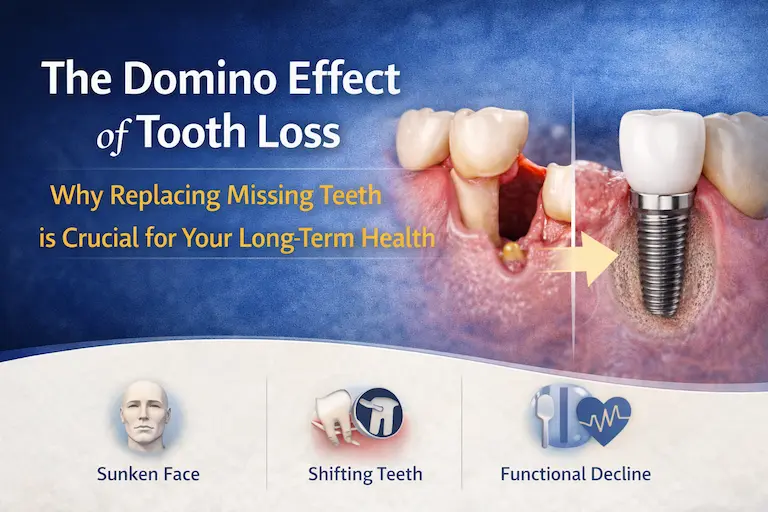
The Domino Effect of Tooth Loss: Why Replacing Missing Teeth is Crucial for Your Long-Term Health
Losing a tooth is often seen as a purely cosmetic issue. After all, if the tooth isn’t visible when you smile, or if it doesn’t hurt, is it really an emergency?
The answer, based on decades of dental and medical research, is a resounding yes.
At our practice, we believe in treating the whole person, not just the symptom. When a tooth is lost and not replaced, it triggers a biological and structural cascade within your mouth that can lead to significant health problems down the road. While dentures and bridges have served patients well for years, modern science has established dental implants as the gold standard for replacing missing teeth—not just for looks, but for preserving the very architecture of your face and health.
Here is exactly what happens when you lose a tooth, and why implants are so vital.
The Silent Destruction: What Happens When You Don’t Replace a Tooth
When a tooth is gone, the body receives a powerful signal: the work in that area is done. This begins a process of biological breakdown that affects three critical areas: the bone, the neighboring teeth, and your overall health.
- Bone Loss (Resorption): The Foundation Crumbles
This is the most critical and irreversible consequence of tooth loss. Your jawbone is unique in the body because it requires stimulation to maintain its density and volume. This stimulation comes from the roots of your teeth every time you chew or bite.
When a tooth root is removed (or falls out), the bone in that area no longer receives that mechanical stimulus. As a result, the body begins to resorb (break down) the bone, treating it as an unused resource. Studies show that within the first year after tooth loss, 25% of the bone width can be lost, and overall, patients can lose 40-60% of bone volume in the area over the next few years .
This is not just a dental issue. This bone loss changes the shape of your face, leading to a “sunken” appearance, premature aging, and deepening wrinkles around the mouth (often called “pursing” of the lips).
- The Domino Effect on Neighboring Teeth
Your teeth exist in a delicate state of equilibrium. When one is removed, the structural integrity of the entire arch is compromised.
- Shifting and Drifting: Adjacent teeth begin to tilt or lean into the empty space. Opposing teeth (on the other jaw) start to super-erupt or grow out of their sockets because there is nothing to stop them.
- Collapse of Bite: This shifting alters your entire bite pattern (occlusion). It can lead to:
- Jaw pain and TMJ disorders: Uneven forces on the jaw joint can cause chronic pain, clicking, and headaches.
- Difficulty chewing: An unstable bite makes eating certain foods painful or impossible.
- New decay and gum disease: Crooked, tilted teeth create hard-to-clean areas where plaque and bacteria thrive, setting the stage for cavities and periodontal disease on the remaining teeth .
- Functional Decline and Nutritional Impact
This is where the structural meets the systemic. As your bite collapses and chewing becomes less efficient, you naturally begin to avoid certain foods. Multiple studies have shown that individuals with missing teeth often shift to a diet that is softer and easier to chew but higher in saturated fats and cholesterol, and lower in fiber .
This dietary shift can increase the risk of developing cardiovascular disease, diabetes, and other chronic conditions. Chewing is the first step of digestion; when that step is compromised, your entire nutritional intake suffers.
Why Implants Are Different: Mimicking Nature
Traditional tooth replacement options—bridges and dentures—address the cosmetic gap but fail to solve the biological problem of bone loss.
A traditional bridge replaces the top of the tooth (the crown) but does nothing to stimulate the bone underneath. Over time, the bone where the tooth is missing will continue to deteriorate, potentially causing the gums to recede under the bridge and compromising the long-term health of the anchor teeth.
Dental implants are the only tooth replacement option that replaces the entire tooth structure—both the visible crown and, crucially, the root.
The Science of Osseointegration
An implant is a small titanium or ceramic post surgically placed into the jawbone. Titanium has a unique property called osseointegration. This means the living bone tissue actually bonds with the surface of the implant, creating a permanent, structurally sound anchor .
Because the implant fuses with the bone, it provides the exact same mechanical stimulation that a natural tooth root does. This “tricks” the body into preserving the bone, halting the resorption process and maintaining facial structure .
The Long-Term Benefits of Choosing Implants
- Preserves Jawbone: This is the single greatest advantage. Implants prevent the sunken-face appearance and maintain the bone for future health.
- Protects Natural Teeth: Unlike a bridge, which requires shaving down healthy adjacent teeth for support, an implant stands alone. It does not compromise the integrity of your remaining healthy teeth .
- Restores Function: Studies show that implants restore chewing efficiency to near-natural levels (far surpassing dentures), allowing you to maintain a healthy, varied diet .
- Unmatched Longevity: With proper care, implants have a success rate of over 95% and are designed to last a lifetime, making them a cost-effective solution compared to bridges or dentures that may need replacement every 5-10 years .
The Takeaway: Act Now to Protect Your Future
Tooth loss is not a static event; it is the beginning of a degenerative process. The bone loss that follows is time-sensitive. The longer you wait to replace a missing tooth, the more the bone deteriorates. If too much bone is lost, it can become difficult or impossible to place an implant without first undergoing complex bone grafting procedures.
Replacing a missing tooth with a dental implant is an investment in your structural integrity, your nutritional health, and your quality of life. If you are living with a missing tooth or are facing an extraction, we encourage you to schedule a consultation. It is never too early to stop the domino effect.
Your smile—and your body—will thank you for it.
Ready to Book Your Appointment?
Looking for a trusted dentist in Rockwood? Our team at Ridge Square Dental is here to provide comfortable, personalized care for you and your family.
Ridge Square Dental
167 Jolliffe Ave, Unit 7, Rockwood, Ontario, N0B 2K0
We proudly welcome patients from Rockwood, Guelph, Acton, Georgetown, Milton, and Fergus.