
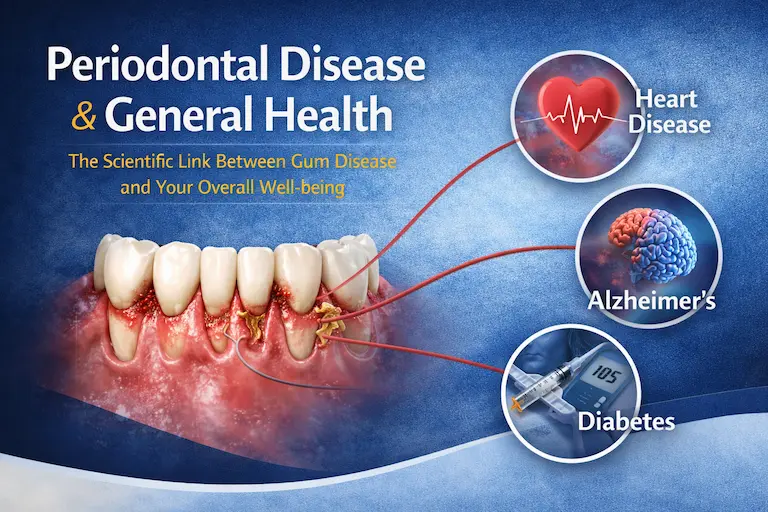
Periodontal Disease & General health
Beyond Your Smile: The Scientific Link Between Gum Health, Alzheimer’s, Heart Disease, and Your Body
As your partner in health, we believe in looking at the bigger picture. For decades, dentistry focused solely on the mouth. Today, a revolutionary shift in medicine recognizes that your mouth is a window to your body—and the health of your gums could significantly influence your risk for some of the most serious chronic inflammatory diseases.
We are not here to hypothesize or scare you. We are here to share the facts based on current, peer-reviewed science. Research has increasingly shown that periodontal (gum) disease is not just a dental issue; it is a complex chronic inflammatory condition that shares biological pathways with Alzheimer’s disease, heart disease, diabetes, and rheumatoid arthritis .
Let’s explore what the evidence actually says about these connections.
The Silent Epidemic: Understanding Periodontal Disease
First, it helps to understand what gum disease really is. It begins when bacterial plaque builds up on teeth, triggering inflammation in the gums (gingivitis). If left untreated, it progresses to periodontitis—a chronic inflammatory disease that destroys the supporting structures of the teeth, including the bone .
This is incredibly common. In the United States, 42% of adults aged 30 or older have periodontitis, with nearly 8% suffering from the severe form . Globally, over 1 billion people are affected . But why should we care beyond saving teeth? Because the inflammation caused by this condition doesn’t stay in the mouth.
The “Inflammatory Fire” and Your Bloodstream
The critical link between gum disease and systemic illness lies in chronic inflammation and bacterial spread.
Think of periodontitis as a chronic “inflammatory fire” at the gumline. In a healthy state, the gums form a tight seal. In a diseased state, this seal breaks down, creating ulcerated pockets. This allows bacteria and their toxic byproducts—like lipopolysaccharides (LPS)—to enter your bloodstream . This is called bacteremia .
Once in the blood, these pathogens travel to distant organs. More importantly, your body’s immune response kicks in. To fight the perceived threat, the liver and other tissues release systemic inflammatory markers, such as C-reactive protein (CRP), interleukin-6 (IL-6), and tumor necrosis factor (TNF) . These are the same cytokines implicated in many other inflammatory diseases.
Here is how this process connects to specific conditions.
The Heart Connection: Periodontal Disease and Cardiovascular Disease
The relationship between gum health and heart health is one of the most studied areas in oral-systemic medicine. In January 2026, the American Heart Association (AHA) published an updated scientific statement reviewing this link .
What the Evidence Shows
According to the AHA, studies demonstrate an association between periodontal disease and a range of cardiovascular issues, including coronary artery disease, heart attack, and stroke . In fact, data suggests that individuals with periodontitis may have a 25% increased risk of coronary heart disease .
How It Happens
- Direct Invasion: Periodontal bacteria (like Porphyromonas gingivalis and Filifactor alocis) have been found directly within atherosclerotic plaques (the fatty deposits in arteries) .
- Systemic Inflammation: The inflammatory markers triggered by gum disease (like CRP) are known to drive atherosclerosis—the thickening and hardening of artery walls .
- Vascular Damage: The bacteria can trigger endothelial dysfunction, which is an early step in the process of blood vessel damage .
It is important to note the AHA clarifies that while a causal link has not been definitively proven, the evidence strongly supports an independent association, and treating gum disease can improve intermediate markers like endothelial function and inflammatory levels .
The Brain Connection: Oral Health and Alzheimer’s Disease
Perhaps the most startling research involves the brain. A 2025 scoping review published in the Japanese Dental Science Review confirms a bidirectional relationship between oral health and Alzheimer’s Disease (AD) .
What the Evidence Shows
Poor oral health—specifically periodontitis and tooth loss—is associated with an increased risk of cognitive decline and Alzheimer’s . One large cohort study found that poor oral health was associated with a more than two-fold higher risk of developing Alzheimer’s .
The Proposed Pathways
- Neuroinflammation: Just as inflammation damages arteries, it can damage the brain. The systemic inflammatory cytokines (like TNF-α and IL-1β) originating from gum disease can cross the blood-brain barrier and contribute to neuroinflammation, a hallmark of Alzheimer’s .
- Amyloid-β Pathways: Research is exploring how periodontal pathogens may influence amyloid-β production—the protein that forms the plaques in the brains of Alzheimer’s patients .
- Bacterial Translocation: There is even evidence suggesting that oral bacteria or their components can migrate to the brain tissue .
This does not mean gum disease causes Alzheimer’s, but it acts as a significant contributor to the inflammatory burden that likely accelerates the disease process in susceptible individuals .
The Domino Effect: Other Chronic Inflammatory Diseases
The inflammatory pathways don’t stop at the heart and brain. Periodontitis is now considered a key player in Systemic Inflammatory Multimorbidity (SIMM) —the coexistence of multiple inflammatory diseases in one person .
- Diabetes: This is a well-known bidirectional relationship. Inflammation from gum disease worsens insulin resistance and glycemic control, while high blood sugar increases the risk of infection and severe gum disease. Treating one condition improves the other .
- Rheumatoid Arthritis (RA): Gum disease and RA share common inflammatory pathways, particularly TNF-α. Furthermore, the key periodontal pathogen P. gingivalis can produce an enzyme that triggers a process (citrullination) linked to the autoimmune attack seen in RA .
- Respiratory Diseases: Bacteria from the mouth can be aspirated into the lungs, contributing to pneumonia and exacerbating conditions like Chronic Obstructive Pulmonary Disease (COPD) .
What This Means for You: A Call to Action
While science has yet to prove that treating gum disease will prevent a heart attack or Alzheimer’s, the evidence is clear: chronic oral inflammation is an added burden on your systemic health.
The AHA statement emphasizes that identifying and treating periodontal disease may help decrease inflammation and promote cardiovascular health . Similarly, maintaining oral health throughout life appears to be a practical, cost-effective strategy for promoting cognitive health .
Protecting Your Health
- See Gum Disease as a Health Issue: Don’t ignore bleeding gums. Bleeding is a sign of inflammation, and that inflammation is impacting your whole body.
- Manage Risk Factors: Smoking, diabetes, and poor nutrition worsen both gum disease and systemic inflammation .
- Interdisciplinary Care: As the research suggests, dentistry and medicine must move closer together . We are here to work with your physician to manage your overall inflammatory burden.
Your mouth is not an island. By taking care of your gums, you are investing in a healthier body for years to come. If it has been a while since your last periodontal evaluation, call our office today. It might be one of the most important health decisions you make this year.
Ready to Book Your Appointment?
Looking for a trusted dentist in Rockwood? Our team at Ridge Square Dental is here to provide comfortable, personalized care for you and your family.
Ridge Square Dental
167 Jolliffe Ave, Unit 7, Rockwood, Ontario, N0B 2K0
We proudly welcome patients from Rockwood, Guelph, Acton, Georgetown, Milton, and Fergus.